In the world of heavy industrial lifting, precision and clarity are not just matters of efficiency – they are matters of life and safety. One of the most common points of confusion for project managers, procurement specialists, and even some equipment operators is the distinction between various capacity ratings. Specifically: Is the 20-ton capacity of a gantry crane the same as the hoist capacity?
At first glance, it seems like a simple “yes.” If you buy a 20 ton gantry crane, you expect to lift 20 tons. However, from an engineering and regulatory perspective, the answer is more nuanced. Understanding the relationship between the gantry structure and the hoisting mechanism is critical for ensuring operational safety, meeting compliance standards, and maximizing the lifespan of your equipment.
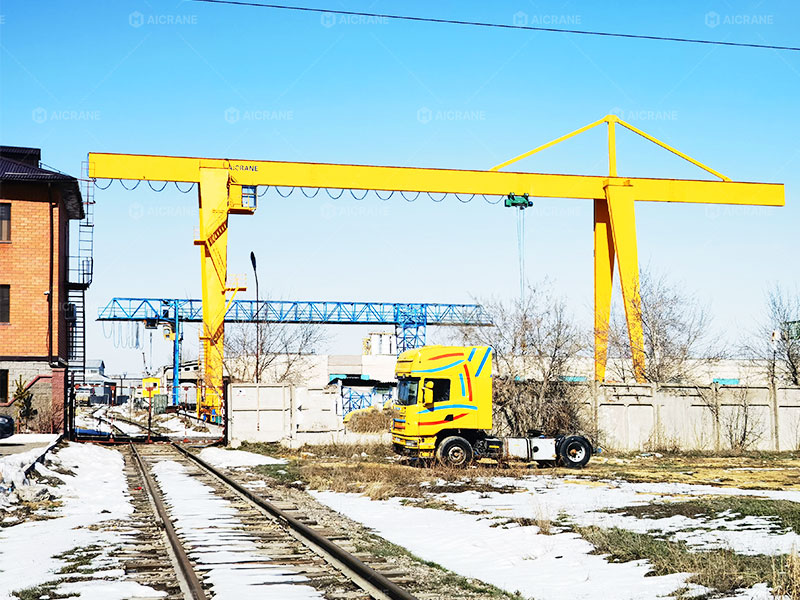
1. Defining Terms: System Capacity vs. Component Capacity
To answer the core question, we must first distinguish between the rated capacity of the system and the rated capacity of the individual components.
The Gantry Crane Capacity (The System)
The “20-ton” rating on a gantry crane typically refers to the Safe Working Load (SWL) of the entire system. This is the maximum weight the crane is engineered to support, including the bridge, the legs, the trolley, and the hoist, under specific environmental and operational conditions. When a gantry crane manufacturer labels a crane as “20 Tons,” they are certifying that the structural integrity of the steel – the girders, the welds, and the support columns – can handle that load plus a specific safety factor.
The Hoist Capacity (The Component)
The hoist is the machinery responsible for the actual vertical movement of the load. A hoist has its own rating based on its motor torque, drum strength, wire rope diameter, and braking system. While a 20-ton gantry crane almost always comes equipped with a hoist capable of lifting at least 20 tons, the hoist is technically an independent mechanical unit.
2. The “Weakest Link” Principle in Lifting
In engineering, a lifting system is only as strong as its weakest component. This is the primary reason why crane capacity and hoist capacity are not always identical in practice.
Scenario A: The Hoist Exceeds the Gantry
In some specialized industrial applications, a user might install a 25-ton hoist on a 20-ton rated gantry structure. Why? Perhaps they require the higher duty cycle or the faster lifting speeds of a larger motor. However, the system capacity remains 20 tons. Even though the hoist is mechanically capable of pulling 25 tons, doing so would risk structural failure of the gantry girders or causing the crane to tip.
Scenario B: The Gantry Exceeds the Hoist
Conversely, if you have a gantry structure rated for 20 tons but equipped with a 15-ton hoist, your actual lifting capacity is strictly 15 tons. The nameplate on the bridge might say 20 tons, but the mechanical limitation of the hoist prevents you from reaching that threshold safely.
3. Gross Capacity vs. Net Capacity: The “Hidden” Weight
The most significant reason why a 20-ton hoist capacity does not equal a 20-ton “payload” capacity involves the difference between Gross Capacity and Net Capacity.
When a hoist is rated for 20 tons, that rating must account for everything hanging below the hoist drum. This includes:
-
The Hook Block: On a 20-ton system, the hook and the pulleys (sheaves) can weigh several hundred pounds.
-
Wire Rope: In high-lift applications, the weight of the wire rope itself becomes a factor.
-
Below-the-Hook Attachments: This is where most confusion occurs. If you are lifting metal plates or concrete precast segments, you likely use a spreader beam, a magnet, or a specialized grab.
If your spreader beam weighs 2 tons and your hoist is rated for 20 tons, your Net Capacity (the actual weight of the cargo you can lift) is only 18 tons. In this context, the hoist capacity and the usable crane capacity are definitely not the same.
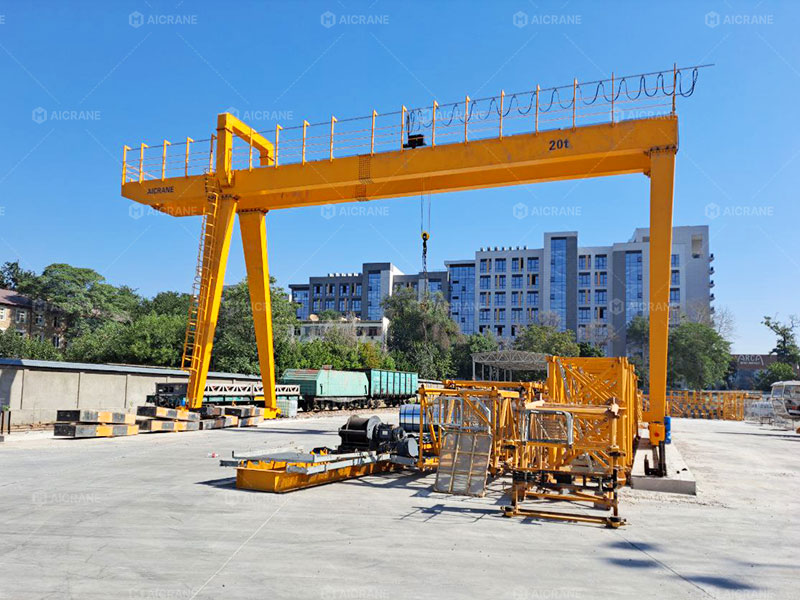
4. Structural Engineering and Deflection Limits
A 20-ton gantry crane is designed with a specific Deflection Limit. Deflection is the “bowing” or bending of the crane’s girder when a load is applied.
For most industrial gantry cranes (following CMAA or ASME standards), the allowable vertical deflection is usually L/600 to L/800 (where L is the span of the crane). If the hoist capacity were to significantly exceed the structural design of the gantry, the girder could deflect beyond its elastic limit, leading to permanent “metal fatigue” or structural deformation.
When engineers match a hoist to a gantry, they ensure that the maximum torque of the hoist motor cannot generate a force that exceeds the structural safety margins of the gantry. This is why “over-hoisting” – trying to pull a load that is stuck or snagged – is so dangerous; the hoist might have the power to keep pulling, but the gantry may not have the structural rigidity to resist that increased force.
5. The Role of Duty Cycles (CMAA Classes)
The capacity of both the hoist and the gantry is also influenced by the Duty Cycle.
-
Class A (Standby/Infrequent): Might lift 20 tons once a week.
-
Class D (Heavy Service): Might lift 20 tons dozens of times a day in a high-production environment.
A “20-ton hoist” on a Class D crane is a much more robust piece of machinery than a “20-ton hoist” on a Class B crane. Even if the weight rating is the same, the thermal capacity of the motors and the wear resistance of the gears differ. If you put a light-duty hoist on a heavy-duty gantry, the hoist will fail long before the gantry does, even if they both share a “20-ton” label.
6. Safety Standards and Load Testing
Regulatory bodies like OSHA (USA), CE (Europe), and various international ISO standards require that the entire system be tested as a unit.
When a 20-ton gantry crane is commissioned, it undergoes a certified load test, typically at 125% of its rated capacity (25 tons). This test validates that the hoist, the brakes, the trolley, the girders, and the legs all function together as a safe system.
The nameplate that is eventually affixed to the crane bridge represents the results of this integrated test. If you replace the hoist later with a different model, the entire crane must be re-rated and re-certified because the balance between component capacity and system capacity has been altered.
7. Practical Implications for Operators
For those working on the ground, the takeaway is clear: Never assume the hoist capacity is the available lifting capacity.
To operate safely, always follow these three steps:
-
Check the System Nameplate: The capacity marked on the bridge is the ultimate ceiling.
-
Subtract the Rigging: Calculate the weight of slings, shackles, and spreader beams.
-
Monitor Environmental Factors: On an outdoor gantry, wind loads can effectively “consume” some of the gantry crane capacity by adding lateral stress to the structure, making a 20-ton lift much riskier than it would be indoors.
Conclusion
Is 20-ton gantry crane capacity the same as hoist capacity? Technically, they are distinct ratings that should be harmonized for safety. The hoist is the “muscle,” and the gantry is the “skeleton.” While a 20-ton crane system requires a 20-ton hoist, the presence of a 20-ton hoist does not automatically mean you can lift a 20-ton object once you factor in rigging weight, safety margins, and structural deflection limits.
For anyone involved in heavy lifting, the goal should be to look beyond the numbers on the side of the machine and understand the physics of the entire system. Only then can you ensure that every lift is executed with the highest standard of safety and efficiency.